I have lost count of how many times a car has rolled into a bay with the same confusing complaint: “The battery tests good, but the dash is totally black. No dome light. No radio. Nothing.” On paper, 12.6 volts sounds healthy. In real life, a total electrical blackout usually means the battery voltage is not reaching the car’s power distribution, or the car has lost its main ground path.
This checklist is the exact order I would follow in a driveway with a basic multimeter and a little patience. We are going to separate four common “power killers” from a battery that is actually empty under load: a blown main fusible link or main fuse, an open cable, a bad chassis ground, and a dead ignition feed.
Before you touch anything: safety and tools
- Key out, vehicle in Park or in gear with the parking brake set.
- Remove rings and watches. A battery can deliver enough current to turn jewelry into a heating element fast.
- If you smell rotten eggs, see battery swelling, or hear hissing, stop and step away. That is a battery safety issue.
- Tools: a digital multimeter, a 10 mm wrench (common battery terminal size), a flashlight, and if you have it, a cheap test light (helpful but not required).
- Be careful probing near the main fuse or battery fuse block. Do not let a meter probe or tool bridge B+ to ground.
Step 1: Confirm what “dead” really means
Turn the headlights on. Try the hazard flashers. Open a door and see if the dome light comes on.
- If anything works (headlights, dome light, hazards), you do not have a total blackout. Focus on the affected branch (ignition/accessory/BCM feeds, relays, ignition switch), while keeping main feeds in mind.
- If nothing works at all, treat it like a main power or main ground failure until proven otherwise.
Step 2: Voltage is not the same as power
A multimeter reading can fool you. A battery can show 12+ volts with limited current delivery under load if there is internal damage, severe sulfation, or a bad connection at the posts.
Do a loaded voltage check before you jump or tow
- Set your meter to DC volts.
- Measure across the battery posts (not the cable clamps): red on the positive post, black on the negative post.
- Apply a load and watch voltage for 10 seconds.
The load matters. In a true blackout caused by an open main feed, the headlight switch may not pull any current at all, so the battery voltage can sit there looking perfect.
- Best load: have a helper attempt to crank the engine while you watch the meter at the battery posts.
- If the car will not crank because it is totally dead: turn on any known working load (hazards, cabin fan, rear defrost) if available. If nothing works, you can only confirm resting voltage here and you must move on to delivery tests in Steps 3 to 6.
- Healthy, charged battery: typically about 12.4 to 12.7 volts resting.
- During cranking: it will drop, but a decent battery typically stays above about 9.6 V while cranking at normal temperatures. The key sign of a weak battery is a rapid drop that stays low (for example, it falls into the 8s or low 9s immediately and does not rebound when you stop cranking).
- If it stays steady at the posts yet the car is still dead, focus on delivery: main fuse, cables, grounds.
If your car is completely blacked out, a jump start may not change anything if the issue is downstream (like a blown main fuse). That is why the next steps matter.
Step 3: Check the terminals like a mechanic
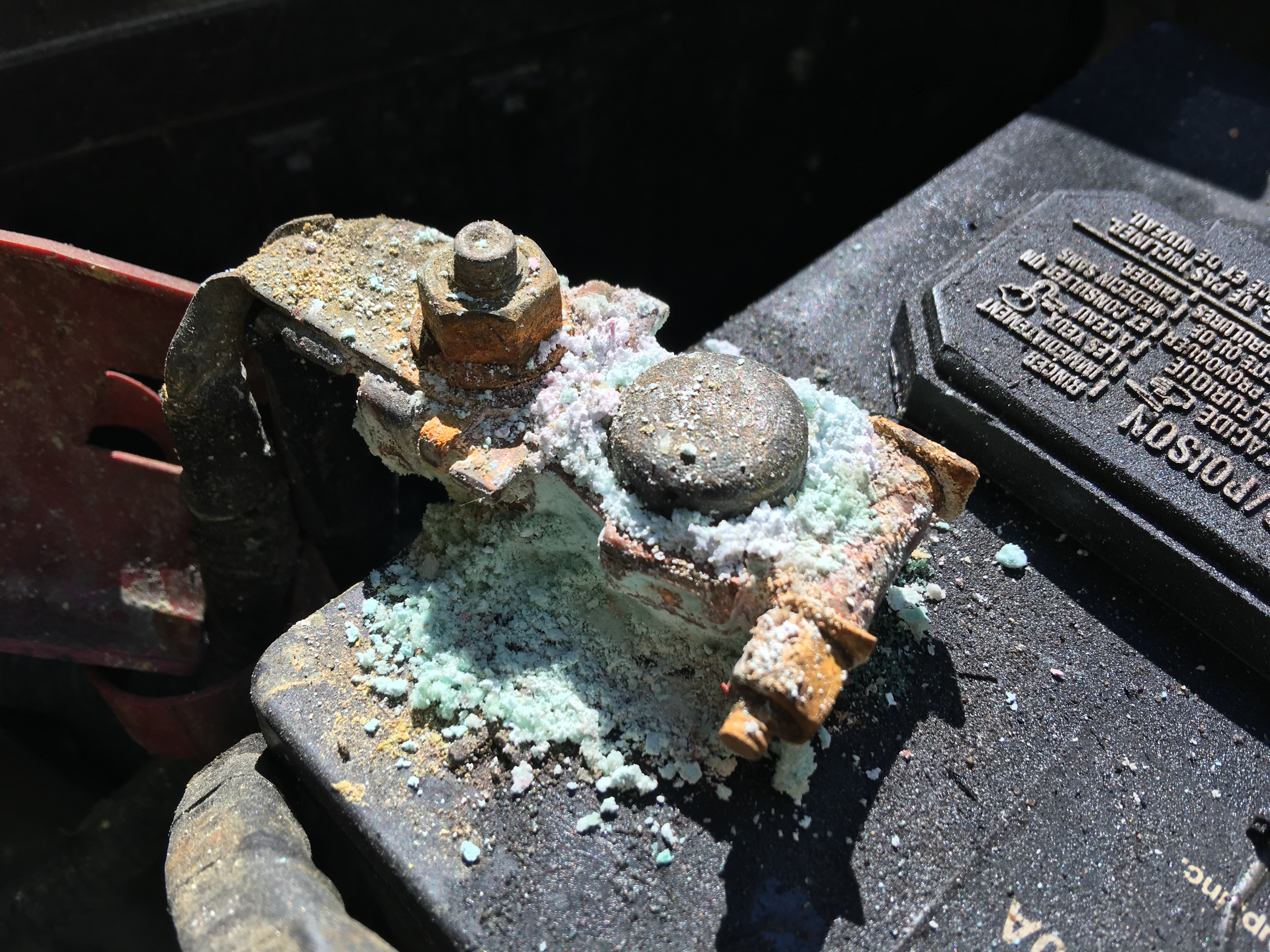
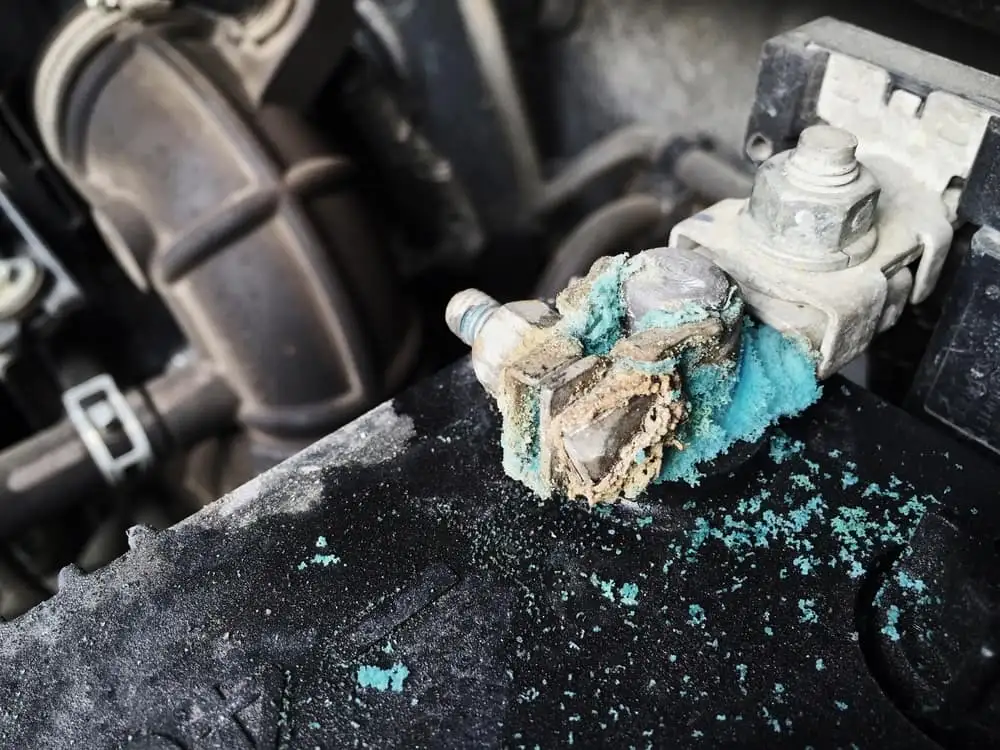
Corrosion between the clamp and the post can look “fine” and still act like an open circuit.
Quick physical checks
- Try to twist each battery clamp by hand. If it rotates on the post, it is loose.
- Look for white or green crust at the clamp edges or wicking into the cable.
- Inspect aftermarket add-ons at the battery (amps, winch, remote start). Poorly done ring terminals can break power to the whole car.
- Check the battery hold-down. A loose battery can shift and cause intermittent contact that looks like a haunted electrical problem.
Two voltage-drop checks that reveal bad connections
These are the fastest “truth tests” I know for a blackout car, but they only mean something with a real load. Use headlights only if they actually illuminate, otherwise use hazards, blower fan, or a crank attempt if any power is present.
- Positive side drop: Put the red probe on the positive battery post and the black probe on the positive cable clamp (the metal clamp, not the post). Turn on a working load or attempt crank. Ideally you see under about 0.05 V. Anything over about 0.1 to 0.2 V is suspicious, and higher is clearly bad.
- Negative side drop: Put the black probe on the negative battery post and the red probe on the negative cable clamp. Again, under 0.05 V is ideal. Over 0.1 to 0.2 V under load points to a bad connection.

Step 4: Check the main ground the right way
A failed chassis ground can cause a total blackout that looks exactly like a dead battery. The battery can test “good” because the battery itself is fine, but the car cannot complete the circuit back to the negative post.
Fast ground presence check
- Keep the meter on DC volts.
- Put the red probe on the positive battery post.
- Put the black probe on a clean metal spot on the engine (lifting bracket, alternator bracket bolt) or the body (unpainted strut tower bolt).
- If you read battery voltage (roughly 12+ volts), you likely have a return path back to battery negative from that point.
- If you read well below battery voltage (for example, only a few volts or 0 V), you likely have a ground problem or you are probing painted or insulated metal. Try a different clean metal point.
This check is good for finding a totally open ground, but it does not prove the ground is healthy under load. For that, do a voltage-drop test.
True ground voltage-drop test (under load)
- Set the meter to DC volts.
- Put the black probe on the negative battery post (the post, not the clamp).
- Put the red probe on clean engine metal.
- Have a helper attempt to crank, or run the strongest load you can (blower on high, hazards, headlights if they work).
- Good: typically under about 0.2 V during heavy load.
- Borderline to bad: 0.3 to 0.5 V or more suggests excessive resistance in the ground path.
- Very bad: around 1.0 V+ means the ground path is severely compromised.
Where grounds commonly fail
- Negative battery cable where it bolts to the body, often near the battery tray.
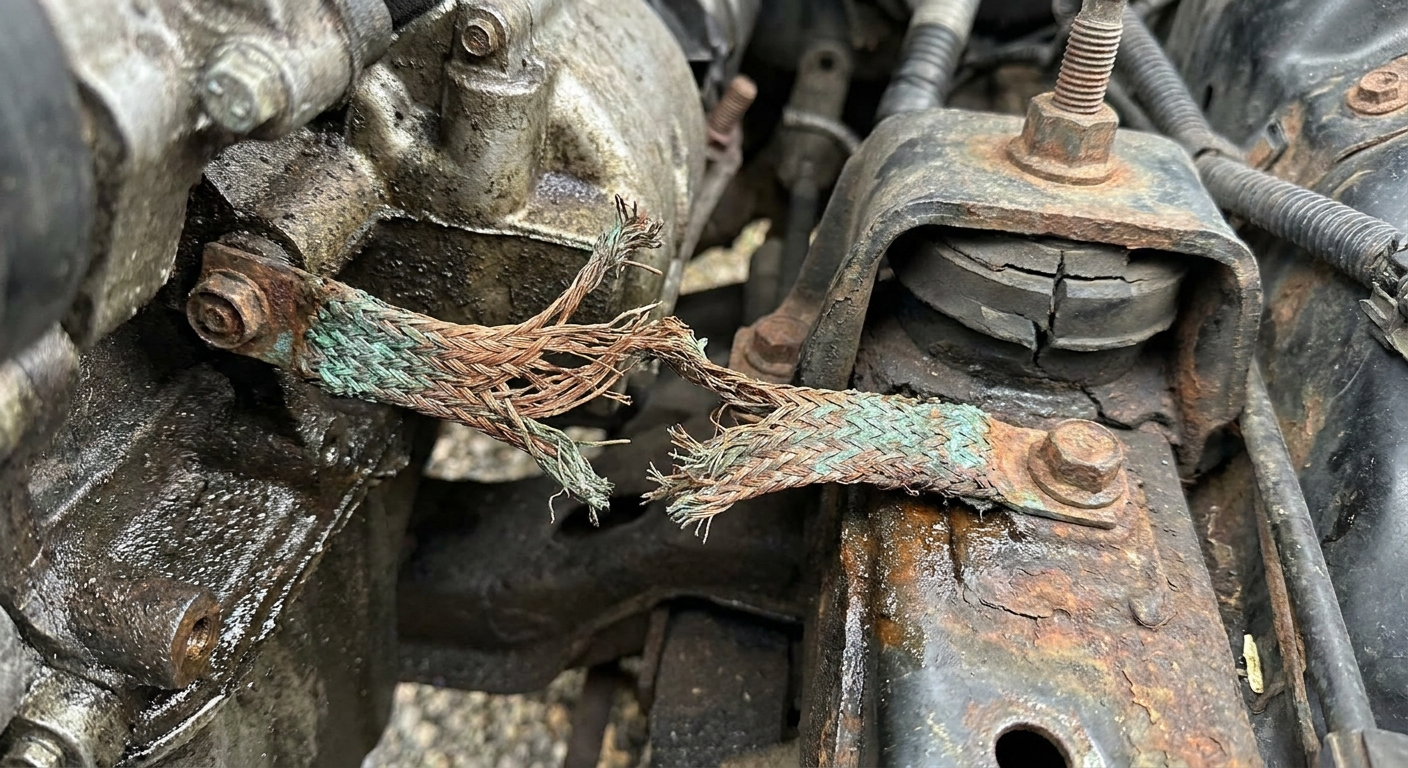
- Engine-to-chassis ground strap (braided strap or heavy cable). If this strap breaks, the entire car can act haunted.
- Hidden corrosion inside the crimped end of the cable, especially in rust-belt cars.
If you have jumper cables, one safe driveway trick is to clamp one end to the negative battery post and the other end to a clean engine metal bracket to temporarily provide a ground path. If everything suddenly wakes up, you just proved a bad ground cable or ground connection. Fix the underlying connection, do not leave it as a permanent solution.
Step 5: Check the main fuse or fusible link
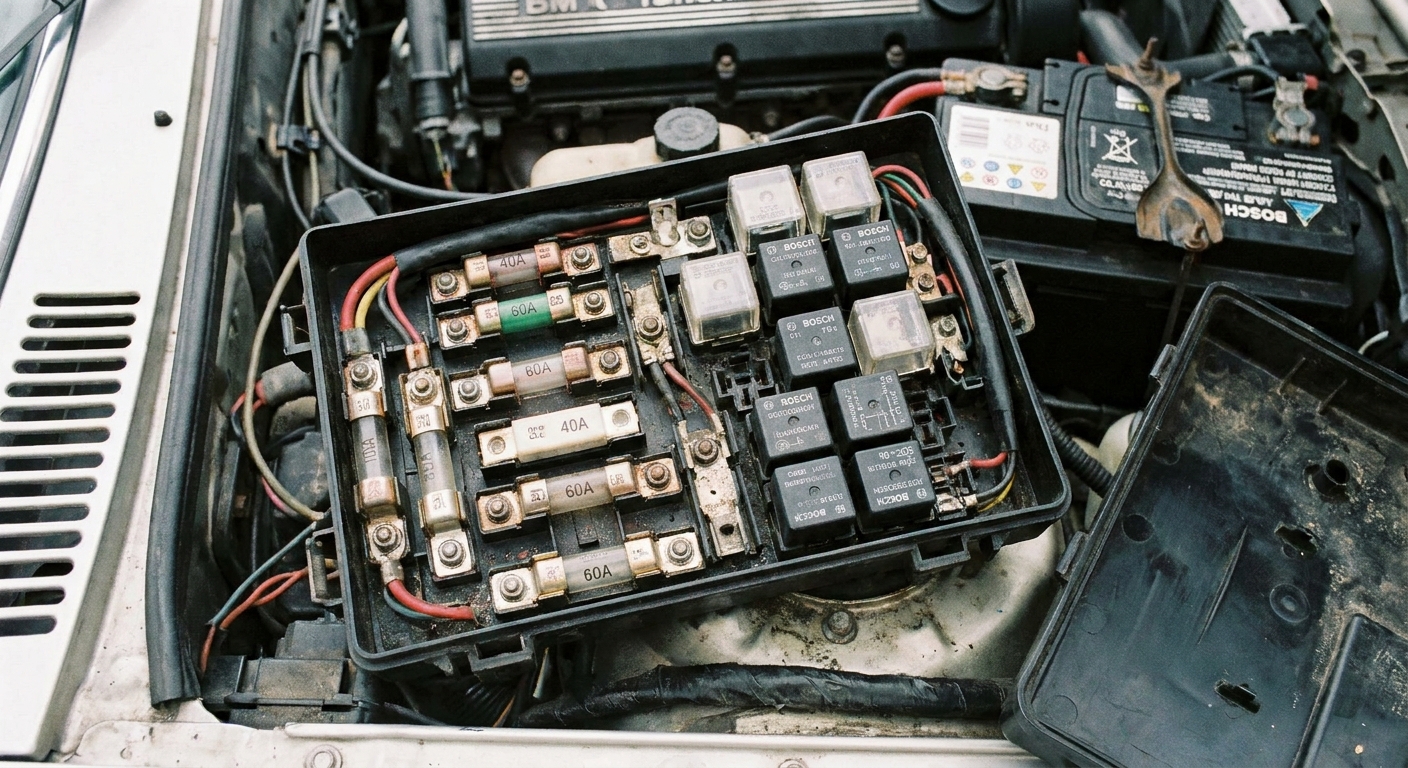
If the battery is healthy and your grounds are intact, the next suspect is the main fuse or fusible link that feeds the entire fuse box. When it opens, the car can go stone-dead while the battery still shows normal voltage.
What you are looking for
- A high-amp MAIN fuse (commonly in the 60A to 200A range, but it depends on the vehicle) in the under-hood fuse box.
- A fusible link near the positive battery cable, sometimes a short section of special wire designed to melt open during a short.
- A battery-mounted fuse block on many modern cars, sometimes integrated into the positive terminal assembly.
How to test it with a multimeter (no guessing)
Leave the battery connected for this test.
- Set meter to DC volts.
- Put the black probe on the negative battery post.
- Probe the input side of the main fuse (or the battery-side lug). You should see battery voltage.
- Probe the output side of the main fuse (the fuse-box feed side). You should see the same battery voltage.
- Voltage on one side only: the main fuse or fusible link is open.
- Voltage on both sides: power is leaving the battery area. Move downstream to the next step.
When a main-fuse failure means stop probing
A main fuse or fusible link usually does not blow for fun. It blows because something drew way too much current, usually a short to ground or a major wiring fault.
- If your main fuse is blown and you see melted plastic, burnt smell, smoke damage, or hot cables, stop. Do not keep trying to “see what else works.” Get the car towed or call for help.
- If the fuse is blown right after recent work (battery replacement, alternator replacement, stereo install, jump start), do not keep installing new fuses. Find the wiring mistake first.
- If the main fuse is blown and you are not comfortable diagnosing high-current circuits, this is a good handoff point to a shop. A repeated main fuse pop can cook a harness fast.
Step 6: Check for an open positive cable
A battery cable can fail internally. The insulation looks perfect, but inside the copper is green and broken. Sometimes a collision, a sloppy battery hold-down, or corrosion at the crimp does it.
Simple “where did the voltage go?” tracing
With the black probe on the negative battery post, follow the positive path:
- Battery positive post
- Positive clamp
- Battery-mounted fuse block (if equipped)
- Main fuse output
- Large B+ stud at the under-hood fuse box
You should see essentially the same voltage at each point. When you find the first point that becomes significantly lower than battery voltage, you have found the open section or high-resistance connection.
Step 7: Sort “no ignition feed” from main power loss
Sometimes the car is not truly dead. It is only dead in the cabin because the ignition switch feed is missing, an ignition relay is not energizing, or a keyless push-button system is not waking up. That can still look like a blackout if the vehicle’s body module is not powering accessories.
Two quick clues
- Hazards work but dash is dead: likely not a total main battery feed loss. Look at ignition switch, ignition relay, body control module feeds, immobilizer, or keyless start wake-up issues.
- Nothing works anywhere: stay focused on main power and grounds. That is almost always upstream of the ignition switch.
Driveway check: does the interior fuse panel have power?
If you can access the interior fuse panel, pick a fuse that should have constant power (often labeled DOME, ROOM, or BCM). With your black probe on the negative battery post, probe the tiny test point on the top of the fuse.
- Battery voltage at the fuse: you have power reaching the cabin. Your issue may be ignition feed, module wake-up, or a specific relay.
- No voltage at any interior fuses: you have a main feed issue between the battery and the cabin, or a main fuse or link problem under the hood.
Common gotchas that mimic a blackout
- Battery disconnect switch: some vehicles and many RV or fleet setups have a disconnect at the battery. Make sure it is on and making solid contact.
- Aftermarket alarm or remote start kill: a poorly installed cut-in can interrupt ignition feeds or even main power distribution.
- Crash-triggered battery safety terminal: some cars use a pyrotechnic battery disconnect or battery safety fuse that can open after a crash event. If the vehicle recently had an accident, airbag deployment, or even hard impact, this becomes a real possibility and usually requires model-specific procedures.
Before you jump it (and when a jump is pointless)
If the dash is dark and the radio is dead, I do three checks before I reach for jumper cables:
- Battery posts voltage under a real load (Step 2). If the car cannot apply a load because it is totally dead, do not let a pretty 12.6 V reading talk you into ignoring delivery checks.
- Terminal connection voltage drop at both clamps under load (Step 3).
- Main fuse or fusible link voltage on both sides (Step 5).
If the main fuse or fusible link is open, a jump start typically does nothing because the jump power cannot get past the open circuit. If the terminals are loose or corroded, jumping can be inconsistent and can create heat at the bad connection.
When to stop and tow
- You find a blown main fuse plus any sign of overheated wiring, melted fuse box, or burning smell.
- The main fuse keeps blowing immediately after replacement.
- The battery cables are hot to the touch or the terminals are arcing.
- You cannot get stable voltage readings because the system power is cutting in and out.
Electrical shorts can go from “no dash” to “no harness” surprisingly fast. When in doubt, stop and get a pro involved.
Quick cheat sheet: what symptoms point to
- Battery shows 12.6 V, but post-to-clamp voltage drop is high under load: dirty or loose battery terminals.
- Battery shows 12+ V, nothing works, main fuse has power on one side only: blown main fuse or fusible link.
- Battery good, main fuse good, but voltage becomes much lower between battery and fuse box stud: open positive cable or failed battery fuse block connection.
- Ground drop is high (battery negative post to engine metal) under load: bad chassis ground, broken engine strap, or corroded ground connection.
- Hazards or headlights work but cluster and accessories do not: lost ignition feed, relay, ignition switch, module wake-up, or immobilizer related issue.
FAQ
My multimeter shows 12 volts. Why is everything still dead?
Because voltage at the battery does not guarantee the car is receiving power. A blown main fuse, a bad battery terminal connection, an open cable, or a failed ground can leave you with normal battery voltage and a completely dead vehicle.
Can a bad ground cause a totally dark dash?
Absolutely. If the negative cable connection to the body is corroded or the engine-to-chassis strap is broken, current cannot return to the battery. The car can appear 100 percent dead. The quickest confirmation is a ground voltage-drop test under load.
Is it safe to replace a blown main fuse in the driveway?
You can replace it, but you should treat it as a warning sign. If it blew due to a short, replacing it without finding the cause can lead to repeated fuse failures and possible harness damage. If there is any melting, burning smell, or immediate re-blow, stop and tow it.
What is the most common cause of total power loss?
In my experience: battery terminal issues and main fuse or fusible link problems, especially after recent battery work, jump starts, alternator replacements, or accessory installs.