If your car suddenly feels sleepy off the line, starts smelling like rotten eggs, or throws a stubborn check engine light , your catalytic converter might be waving a red flag. The tricky part is that a failing converter can look like a lot of other problems, from a misfire to a tired oxygen sensor.
One quick framing point that saves a lot of confusion: some converters are restricted or clogged (that causes power loss), while others are simply not cleaning emissions efficiently (that often drives fine but trips a code).
Let’s walk through the five most common warning signs I see in the shop, what they usually mean, and what you can expect to pay to fix it.
What a catalytic converter does (in plain English)
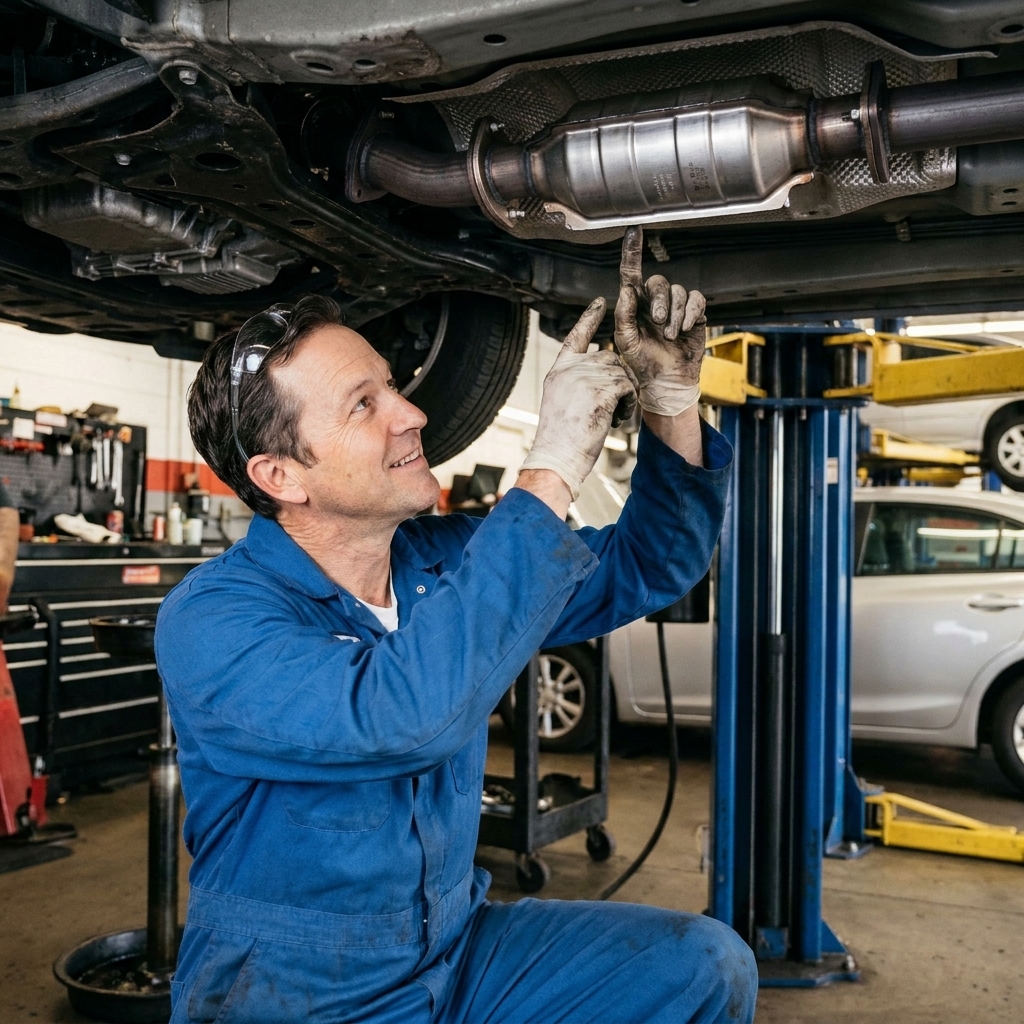
Your catalytic converter (the “cat”) sits in the exhaust and uses a coated honeycomb inside to turn nasty emissions into less harmful gases. When it’s healthy, you never think about it. When it’s clogged, damaged, or contaminated, it can choke the engine like a blocked muffler, and the computer will often notice before you do.
5 warning signs your catalytic converter is failing
1) Sluggish acceleration and loss of power
A clogged converter restricts exhaust flow. Engines are air pumps, so when the exhaust cannot get out, fresh air and fuel cannot get in as efficiently. The result is a car that feels heavy, especially when merging, climbing hills, or passing.
- What it feels like: power drops off at higher RPM, slow 0 to 60, sometimes a “won’t rev” sensation.
- Common confusion: bad spark plugs, failing fuel pump, dirty throttle body, or a transmission issue.
2) Check engine light (often with P0420 or P0430)
These are the classic catalyst efficiency codes: P0420 (bank 1) and P0430 (bank 2). The engine computer compares the upstream and downstream oxygen sensor signals and looks at how much the converter is smoothing out those fluctuations (think oxygen storage and cleanup). If the downstream signal starts acting too much like the upstream, it suspects the converter is no longer doing its job.
- Important: a P0420 code does not always mean the converter is bad. Exhaust leaks, lazy O2 sensors, and engine issues like misfires can also trigger it.
- Related codes to watch:
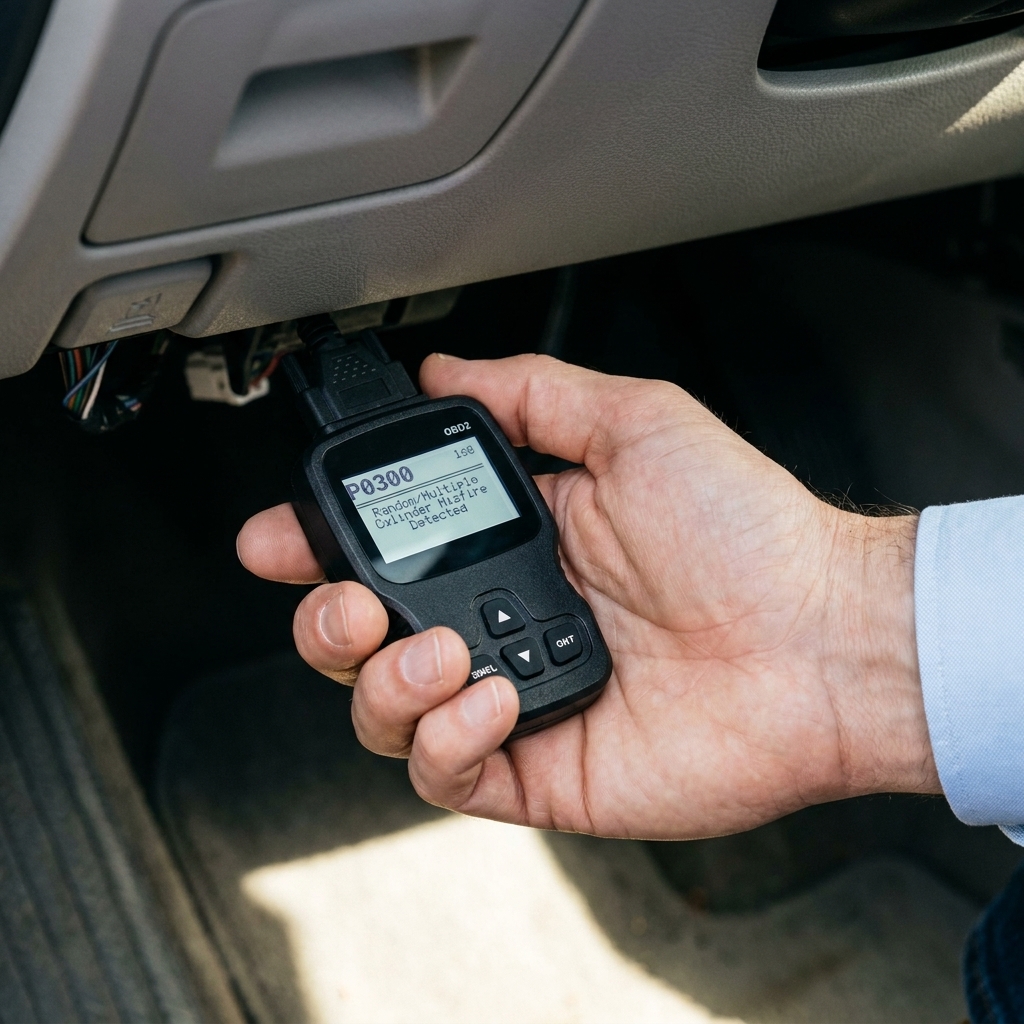
P0300toP030x(misfires) andP0171/P0172(lean or rich). Those can be the real problem, and they can also kill a converter. - Don’t ignore it: driving with an underlying misfire can overheat and destroy a good converter fast.

3) Sulfur or rotten-egg smell from the exhaust
That rotten-egg odor can be hydrogen sulfide. A healthy converter typically minimizes it. When the converter is overheated, contaminated, or the engine is running rich, the smell can become noticeable, especially after a hot drive.
- What it can point to: a converter that is overheating or contaminated, or an engine running rich due to fueling issues.
- Quick note: fuel sulfur content and some additives can contribute to mild odors, but a strong, persistent sulfur smell is worth checking out.
4) Rattling noise under the car (especially at start-up)
If the ceramic honeycomb inside the converter breaks apart, it can rattle like a tin can with rocks in it. You will often hear it at idle, during start-up, or when you blip the throttle. Sometimes the rattle comes and goes as the broken material shifts.
- What it means: internal damage, usually from impact, overheating, or age.
- Why it matters: broken pieces can shift and partially block exhaust flow, causing sudden power loss.

5) Failed emissions test or poor fuel economy
A converter that cannot store and burn off pollutants properly often shows up at inspection time. Fuel economy can also drop, but it is usually an indirect effect: the engine is running rich, misfiring, or fighting exhaust restriction, and that extra fuel use is the symptom.
- What it looks like: you pass everything else but fail catalyst efficiency, or you get borderline numbers that were not an issue before.
- Related symptom: a rough idle or hesitation can happen when an engine problem is damaging the cat, not just because the cat is restricted.
Stolen vs failing: the quick tell
This comes up constantly now. A failing converter usually gives you a code, a smell, a rattle, or a gradual loss of power. A stolen converter is typically obvious right away.
- If it was stolen: the car will be deafening on start-up, often like a straight-piped tractor, and you may smell exhaust strongly under the car. You might also see a cut section of pipe underneath.
- If it is failing: it is often still physically there, just not working efficiently or not flowing properly.
What causes a catalytic converter to fail
Converters do wear out, but many “dead cats” are victims, not villains. These are the big causes I see:
- Misfires and unburned fuel: raw fuel overheats the converter and melts the honeycomb.
- Oil or coolant burning: from worn rings, valve seals, or a head gasket. Contaminants coat the catalyst and reduce efficiency.
- Running too rich: leaking injectors, bad fuel pressure regulator, dirty MAF sensor, or other fueling issues.
- Impact damage or theft attempts: a dented converter or crushed exhaust can restrict flow. Theft attempts can leave exhaust leaks that trigger codes.
- Age and mileage: especially on vehicles with lots of short trips where the exhaust rarely gets fully hot.
How to confirm it’s the converter (before you spend big money)
Before anyone sells you a converter, it’s smart to confirm the diagnosis. Here are common, legitimate checks a shop will use:
- Scan data review: looking at upstream and downstream O2 sensor activity, fuel trims, and misfire counters.
- Exhaust leak check: small leaks near the converter can mimic catalyst failure.
- Backpressure test: measures restriction in the exhaust, often through an O2 sensor port.
- Temperature test: comparing inlet vs outlet temps with an infrared thermometer (not perfect, but useful with scan data).
- Rule out root causes: fixing a misfire or oil burning issue first so the new converter does not die early.
If you are a DIYer with a basic code reader, you can still gather clues: check for misfire codes, fuel trim issues, and whether the symptom changes when the engine is hot vs cold. But for a firm call, live data and a restriction test are worth paying for.
A simple decision guide
- P0420 or P0430 but it drives fine: check for exhaust leaks, review live O2 data, verify fuel trims, and rule out lazy sensors or rich running.
- Power loss, “won’t rev,” or stalling: prioritize a restriction check (backpressure test) and look for rattle or heat damage.
What it costs to fix (replacement options and real-world ranges)
Catalytic converter costs swing wildly because they depend on emissions rules where you live, the number of converters your vehicle has, and how the converter is built into the exhaust.
Typical cost ranges
- Diagnosis: $100 to $200 (sometimes rolled into repair if you proceed)
- Aftermarket direct-fit converter installed: $900 to $2,500
- Universal converter installed (weld-in): $400 to $1,200 (not legal in all states and not available for every application)
- OEM converter installed: $2,000 to $4,500+ (some vehicles can be higher)
- Oxygen sensor replacement (if needed): $150 to $500 each installed
- Exhaust hardware, gaskets, clamps, broken studs: $50 to $400 extra depending on rust and access
Why the spread is so big: Some cars have the converter integrated into the exhaust manifold (tight access, more labor). Others have multiple cats (bank 1 and bank 2), or a separate front and rear converter setup. Add regional emissions requirements, and pricing can change fast.
Emissions compliance note: in CARB states (California and others that follow CARB rules), converter options can be more limited and more expensive. Many states require EPA or CARB compliant parts, and installing the wrong converter can be illegal and still fail inspection.
Aftermarket vs OEM: which should you choose?
Here’s my practical take:
- OEM: best fit and longest-lasting, usually the safest bet for vehicles that are picky about catalyst efficiency codes.
- Direct-fit aftermarket: good middle ground if you choose a reputable brand and the vehicle is not extremely sensitive.
- Universal: can be cost-effective, but fitment, performance, and legality depend on the application and where you live.
If a shop recommends a converter but cannot explain what caused the old one to fail, pause. The most expensive converter in the world will still die early if the engine is misfiring or burning oil.
Can you drive with a bad catalytic converter?
Sometimes, for a short time. But it depends on what “bad” means.
- If it’s clogged: you risk overheating, stalling, or losing power at unsafe moments.
- If it’s melted or breaking apart: restriction can worsen quickly, and the car may become undrivable.
- If it’s just an efficiency code: the car may run fine, but you can fail inspection and you still need to find the underlying cause.
If you notice a strong sulfur smell, severe power loss, or signs of extreme heat (sometimes a converter can glow red when it is severely overheated), treat it as urgent and get it checked.
Quick FAQ
Will a catalytic converter cleaner fix this?
Additives can help in very specific cases, usually minor deposits, and only if the converter is not physically damaged or melted. If you have a rattle, severe power loss, or repeat P0420 after fixing other issues, cleaner is unlikely to solve it.
Can a bad O2 sensor cause P0420?
Yes. A lazy downstream O2 sensor, wiring issues, or an exhaust leak can mimic converter failure. That’s why live data and leak checks matter before replacing parts.
How long should a catalytic converter last?
It’s common to see converters last 100,000 to 200,000 miles, but engine condition and driving patterns matter more than the odometer. Frequent short trips and unresolved misfires are converter killers.
My bottom-line advice
If your car is showing one or more of these signs, start with a proper diagnosis, not a parts cannon. A catalytic converter is expensive for a reason, and you want to be sure you are fixing the cause, not just the symptom.
If you want, tell me your vehicle year, make, model, engine, and any codes you’ve pulled, and I’ll help you narrow down the most likely culprit and the smartest next step.