I have lost count of how many “my car won’t start” calls turned out to be a key fob with a dead coin cell. The good news is that many modern push-button start cars have a built-in emergency start routine that can work even when the fob battery is completely dead.
This guide stays focused on the key fob battery problem. If your car’s 12-volt battery is dead, that is a different issue with different steps.
First, confirm it is the fob battery
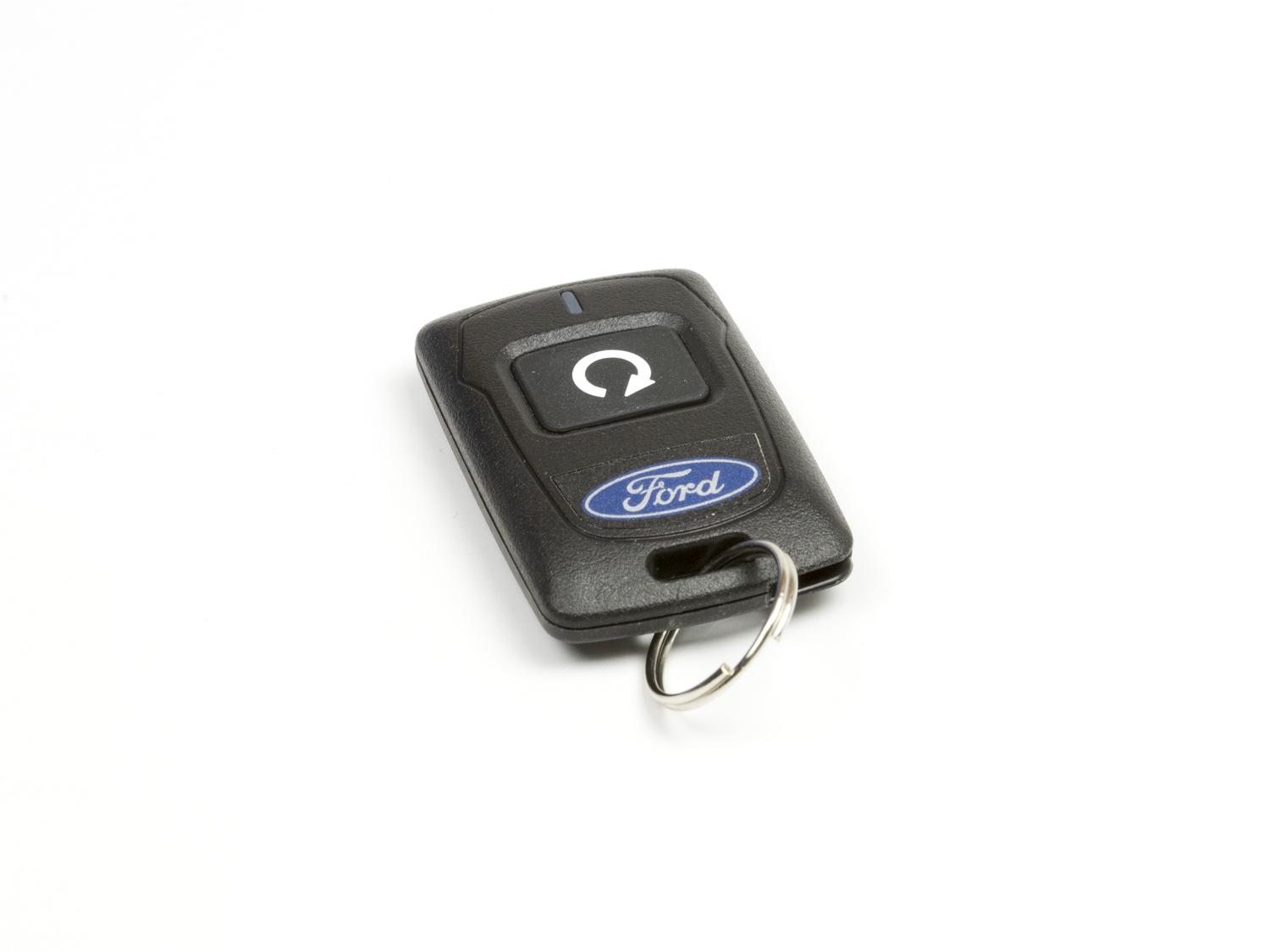
With a dead fob battery, the car is usually fine. The symptoms tend to look like this:
- The doors will not unlock with the fob buttons (or the range suddenly becomes extremely short).
- You may see a message like “Key not detected,” “No key,” or “Key fob battery low.”
- The car may let you in (if you use the door handle sensor on some models) but will not start because it cannot “see” the fob reliably.
What this is not: always a dead vehicle battery. With a weak or dead 12-volt car battery you may see slow cranking, rapid clicking, dim interior lights, or the dash going haywire.
One quick rule of thumb: if your interior lights, dash, and radio are strong, a dead fob battery becomes a prime suspect. Just remember that accessories working does not guarantee the 12-volt battery is healthy enough to start the car, especially in cold weather or with an aging battery.
How to unlock the door with the mechanical key
Most keyless fobs hide a small mechanical key inside. Automakers call it a “backup key,” “emergency key,” or “insert key.” It lets you unlock the driver’s door even if the fob battery is dead.
Step-by-step
- Find the release on the fob. Usually it is a small slider or button on the back or side of the fob.
- Pull out the mechanical key. It is a metal blade that slides out.
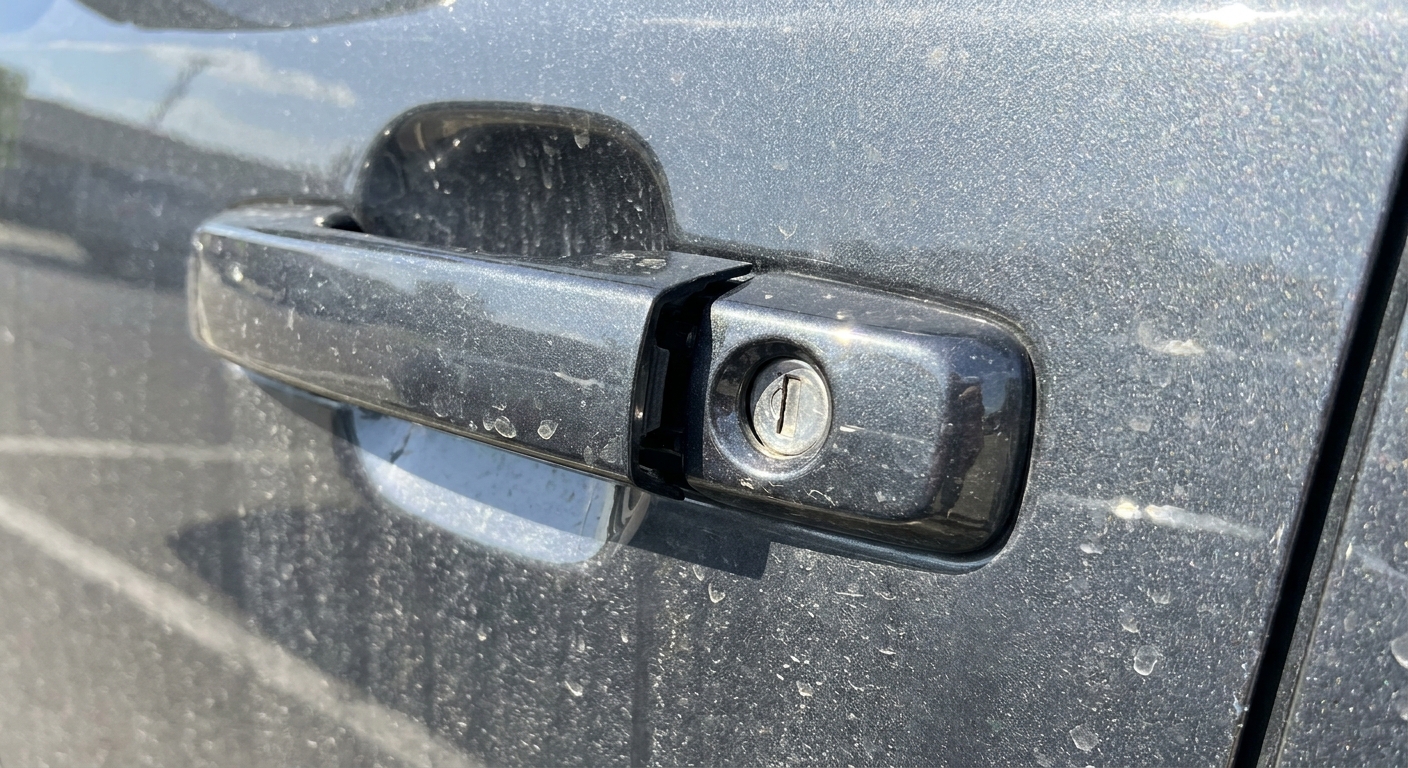
- Locate the hidden key cylinder on the driver’s door. Some cars have an obvious keyhole. Others hide it behind a small cap near the door handle.
- Pop the cap (if equipped). Often the mechanical key itself can gently pry it off using a notch on the underside of the handle area. Use steady pressure, not brute force, so you do not snap the cover tabs. If you have tape or a thin cloth handy, wrapping the tip can help avoid scratching paint.
- Insert the key and unlock. Turn like a normal key.
Heads-up: If the car alarm starts blaring when you unlock the door this way, do not panic. Many vehicles will hush the alarm once the car recognizes the fob during the emergency start procedure (next section).
Emergency start (dead fob battery)
Even with a dead coin cell, the fob itself is usually still a valid ID. Many vehicles can read the fob at very close range through a backup reader or antenna, but you have to put the fob in a very specific spot. The exact routine varies by make and model.
Where to hold the fob
In many push-button start cars, the go-to move is:
- Press the brake (or clutch on a manual).
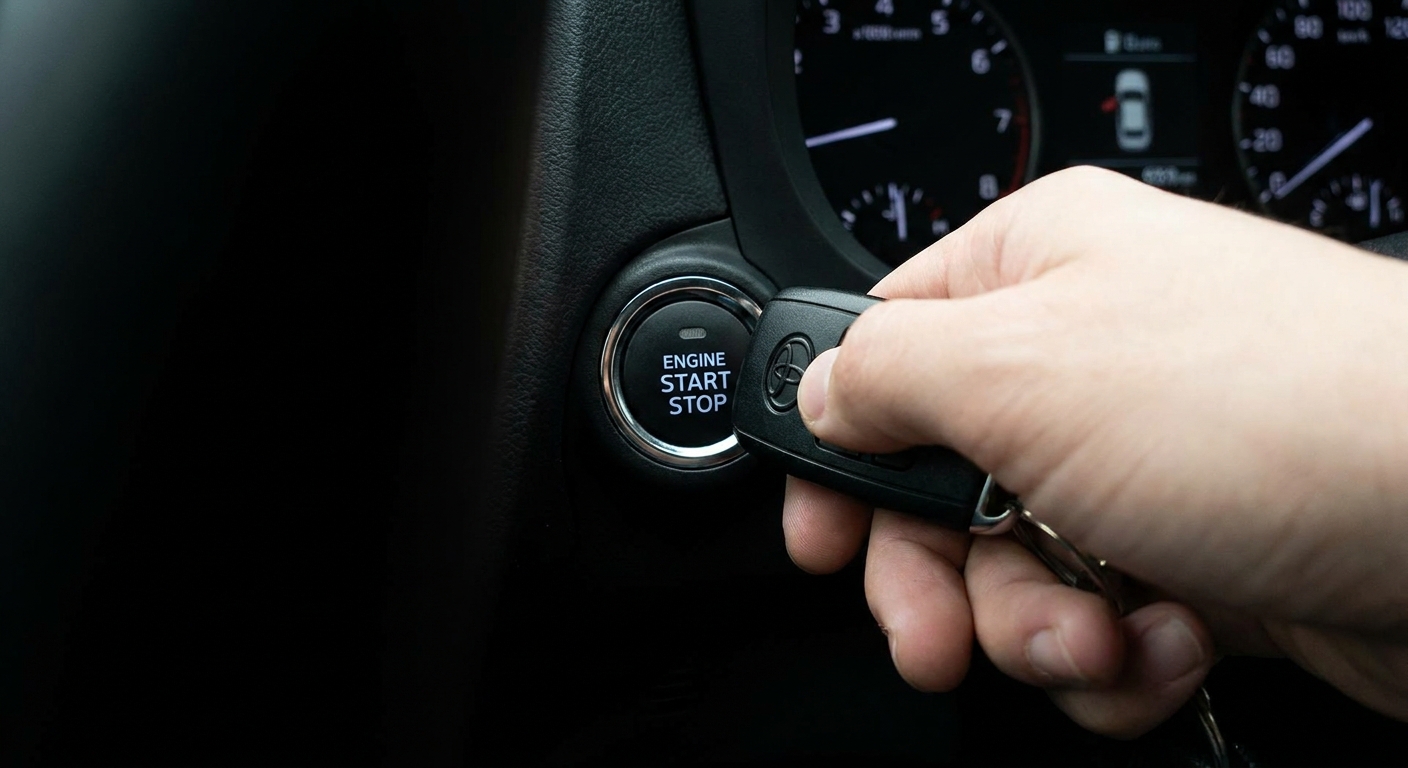
- Hold the fob directly against the START/STOP button (touching it or within an inch).
- Press the START/STOP button while the fob is held in place, and keep it there for a second or two.
That contact point is common because it is easy for the manufacturer to place a receiver behind the button. Some models instead want the fob placed in a backup pocket, like:
- Inside the center console bin
- In a small slot or tray in the console
- Against a marked spot on the steering column
If holding it to the start button does not work, check your owner’s manual for “emergency start,” “dead key fob,” or “key not detected.”
If it still will not start
1) Try fob orientation
Some fobs transmit or couple better when the logo side or the key ring end is closest to the button or backup reader. If it does not work in one orientation, rotate the fob 180 degrees and try again.
2) Press the brake firmly
It sounds basic, but I have seen thick winter boots and half-pressed pedals stop the whole show. Push the brake to the floor and hold it.
3) Clear the area
A pocket stuffed with another fob, RFID badge, or a big key bundle can occasionally interfere. Hold only the problem fob near the start button or backup pocket.
4) Check for a second fob in the car
It is not super common, but if there is another fob inside the cabin, some cars may prioritize the closest fob or behave inconsistently. Move the spare away or out of the vehicle and retry.
5) Cold weather reality check
Extreme cold can make a weak coin cell act dead. If you are stuck in a freezing lot, warming the fob in your hands or inside your jacket for a few minutes can sometimes buy you one more start so you can get home and replace the battery.
If the car seems truly dead: If you get in with the mechanical key but you have no dash lights and the car does nothing, you are likely dealing with the vehicle’s 12-volt battery or connections. At that point you may need a jump start or roadside assistance.
Dead coin cell vs reprogramming
This is the part that trips people up. A dead coin cell is annoying but straightforward. A fob that is no longer paired to the car is a different animal.
Signs it is probably just the fob battery
- The fob worked yesterday, then suddenly got weak or stopped.
- The car intermittently recognizes the fob if you hold it very close.
- You see a “key fob battery low” warning.
Signs it may be an unprogrammed or failed fob
- You replaced the fob battery and nothing changed at all.
- The car will not recognize the fob even when it is held against the start button or placed in the backup pocket.
- The fob has been through water damage, a hard drop, or years of wear and now behaves erratically.
- The car had recent electrical work, module replacement, or locksmith work, and the issue started right after.
If you suspect a programming issue, you will usually need a dealer, a qualified automotive locksmith, or a shop with the right scan tool access to your vehicle’s immobilizer system. Modern systems are designed to prevent DIY pairing for security reasons.
Replace the fob battery
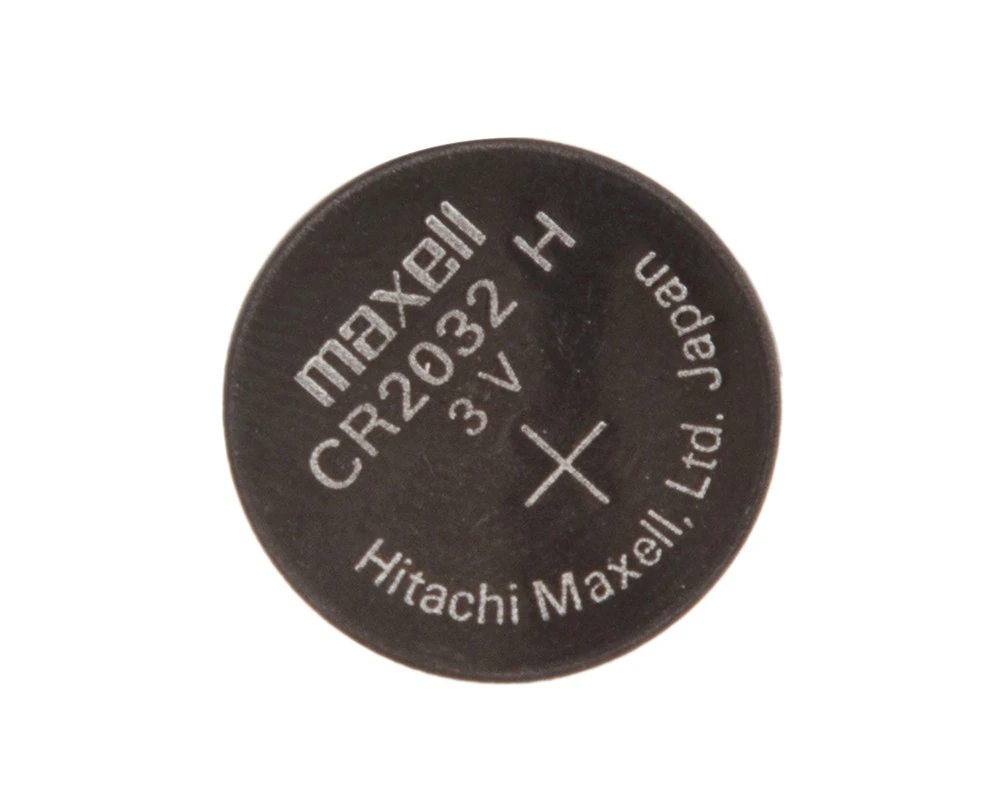
Most fobs use a common coin cell like CR2032 or CR2025, and some use CR2016, but do not guess. Use what is printed on the old battery or listed in your owner’s manual.
- Open the fob case carefully. Many have a small notch where the mechanical key came out, and you can gently twist with the key blade or a small flat tool.
- Note the battery orientation. Install the new cell with the same plus and minus orientation.
- Keep oils and debris off the contacts. It is not the end of the world if you touch it, but handling the new cell by the edges when possible helps keep the faces and fob contacts clean.
- Snap it back together fully. A half-closed fob can pop open in your pocket.
After replacement, test lock, unlock, and remote start (if equipped) from a normal distance.
Safety note: Do not leave spare coin cells loose where kids or pets can access them. Coin cell ingestion is a serious emergency. Dispose of the old battery properly or recycle it where available.
Common shop questions
Will the car start if the key fob battery is completely dead?
Often, yes. The fob battery powers the long-range buttons and the normal proximity signal. Many cars can still read the fob at very close range using a backup method when you press it against the start button or place it in the backup pocket. Not every vehicle uses the same method, so check the manual if the start button trick does not work.
Why does touching the fob to the start button work?
At very close range, the car can sometimes read the fob using a backup reader or antenna. I explain it to customers as “tap-to-start for the key,” but the exact tech behind it varies by manufacturer.
My car says “Key not detected,” but the fob battery is new. Now what?
At that point I start thinking about a damaged fob, a second fob causing weird behavior, or a vehicle-side problem like a weak interior key antenna. A locksmith or dealer can test both the fob and the car’s keyless entry system.
Can a dead fob battery cause the car to shut off while driving?
Almost never. Once the car is running, it does not typically require a constant fob signal to keep the engine on. The risk is that after you shut it off, it may not restart until the fob is recognized again.
Two tips for next time
- Learn the backup start location now. Sit in your driveway and find the spot your car wants the fob when it cannot detect it normally. It is much nicer to learn this on a calm Saturday than in a rainy parking lot.
- Keep a spare coin cell in the glove box. They are small, cheap, and save a ton of hassle. Just store it safely so it cannot end up in a child’s hands.
If you tell me your year, make, and model, I can usually point you to the exact emergency start location and where the mechanical key cylinder is hidden on your door.