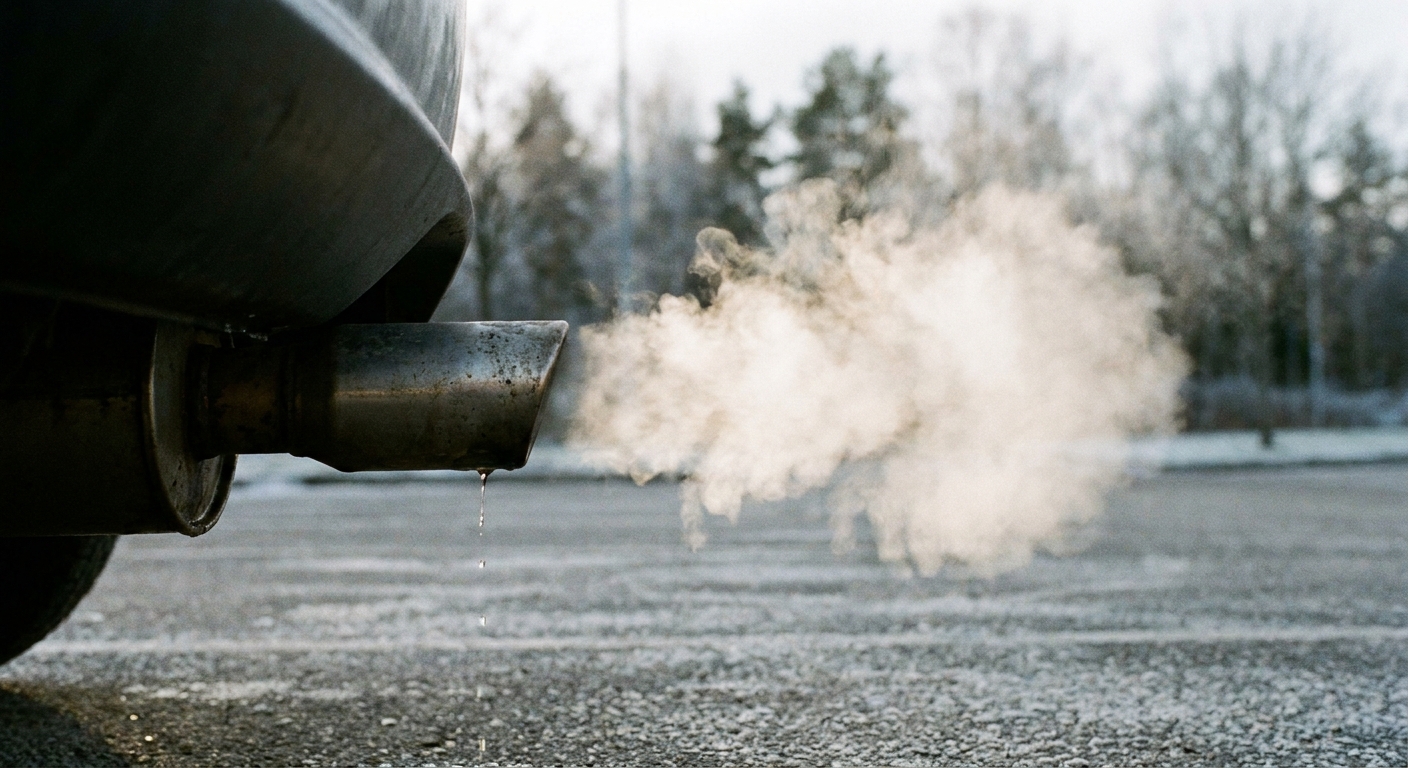
The first time you see it, it can make your stomach drop. You start the car, it fires right up, and for a couple seconds there’s a little blue cloud out the tailpipe. Then it clears and the car runs completely normal.
Often, that brief blue puff is oil that seeped into the engine while it sat overnight, then got burned off right at startup. The key is the timing and how quickly it disappears. A few seconds is one story. Constant blue smoke is a very different one.
One quick reminder: on cold mornings, normal condensation can look like a light white vapor and disappear fast. Blue-tinged smoke hangs a little longer and tends to smell oily.
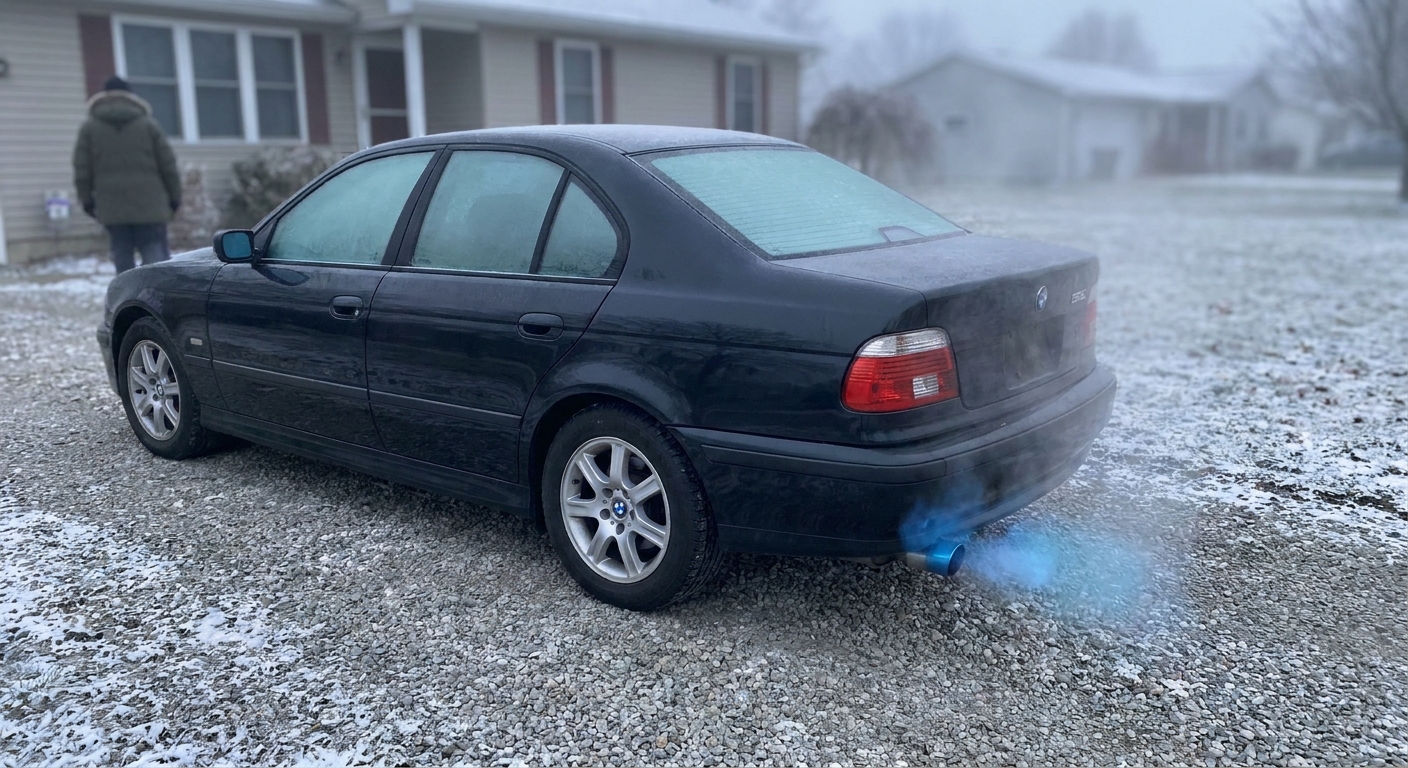
What blue smoke means
Blue-tinged smoke is usually a sign of engine oil being burned in the combustion process. Gasoline exhaust is mostly invisible once the engine is warm and running right. Oil, when it gets into the cylinders or exhaust stream, can burn with that bluish haze and a sharp, oily smell.
So the question is typically not whether something oily is getting burned. The question is how the oil got there, and whether it’s a minor seep or a wear issue that’s getting worse.
Most common cause of a quick puff
Worn valve stem seals (or valve guides)
If you get a blue puff that clears quickly, especially after the car sits overnight, worn valve stem seals are one of the most common culprits on many higher-mileage engines.
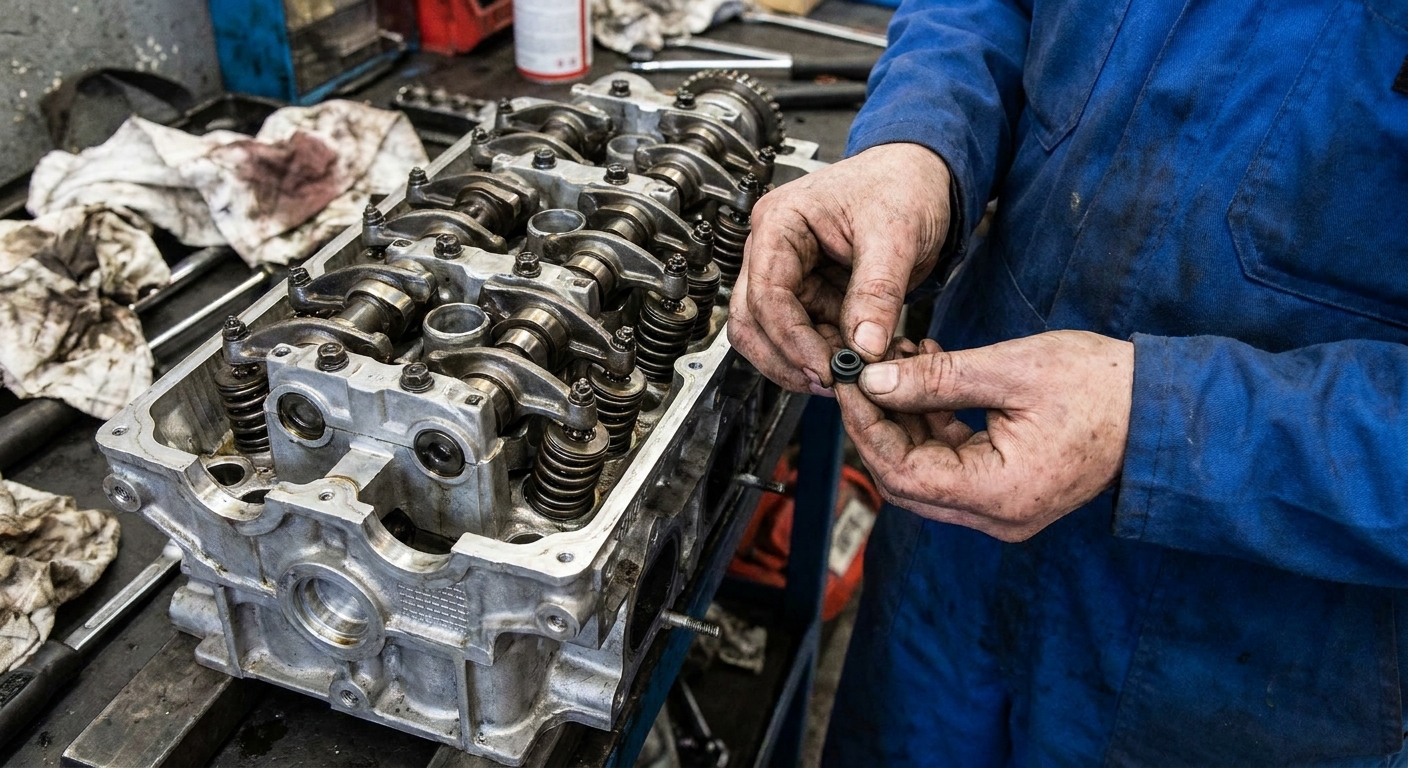
These seals sit at the top of the valves and are there to keep oil (used to lubricate the valvetrain) from running down the valve stems into the combustion chamber.
As the seals age, they harden and shrink. While the engine is off, a small amount of oil can slowly seep past them and puddle on the backside of the intake valve or in the cylinder. On startup, that oil burns, you see a quick blue cloud, and then it’s gone until the next long sit.
Clues that point toward valve stem seals:
- Blue smoke appears right after startup and clears in a few seconds.
- It’s worse after the car sits longer (overnight, or a weekend).
- You may notice a puff after a long downhill coast, then getting back on the throttle.
- Oil consumption is mild at first, but can gradually increase over months.
Other causes of a startup puff
A quick puff does not automatically mean valve stem seals. Depending on engine design, mileage, and whether the car is turbocharged, these can also show up as a brief startup smoke event.
PCV or crankcase ventilation pulling oil
A stuck PCV valve, restricted breather, or high crankcase pressure can encourage oil to get pulled into the intake and burned. On some engines this can show up as a puff after idling, after a long sit, or when you first tip into the throttle.
Turbo oil control issues (turbo engines)
On turbo cars, oil can get into the intake (compressor side) or exhaust (turbine side) when the turbo is worn, its oil control is struggling, or crankcase pressure is pushing oil where it should not go. A turbo problem can still look like a puff at startup at first, then become more frequent.
Oil pooling from overfill
If the oil level is over the full mark, the crank can whip it into foam and the engine can ingest oil through the PCV system. It is a simple check that can save a lot of guesswork.
How this differs from constant blue smoke
If the smoke continues after the first few seconds, or shows up every time you accelerate, you’re usually dealing with a more continuous oil path into the engine.
Piston rings or cylinder wear
Worn rings, worn cylinders, or a stuck oil control ring can let oil ride up the cylinder wall and burn more continuously, not just at startup. This typically shows up as:
- Blue smoke that does not fully clear as the engine warms up
- Blue smoke under load (acceleration) or steady cruising
- Noticeable oil consumption that can range from mild to severe (sometimes as much as a quart every few hundred to thousand miles on a badly worn engine)
- Often accompanied by lower compression, blow-by, or an oily intake tract
Turbocharger oil control (turbo cars)
If your engine is turbocharged, turbo wear and oil control problems can leak oil into the intake or into the exhaust. This can produce blue smoke that may be:
- More noticeable after idling, then revving
- Worse after boost events
- Paired with oily intercooler pipes or excessive oil in the intake tract
A quick puff at startup can still be valve stem seals on a turbo car, but don’t ignore the turbo and crankcase pressure angle if the smoke becomes more frequent or you’re adding oil often.
Do not mix these symptoms up
I want to separate two situations that get mixed up all the time:
Blue smoke after the engine starts (fires and idles)
This is usually oil being burned. If it clears quickly after a long sit, valve stem seals and oil ingestion through the PCV system are common suspects.
Vapor while the engine is cranking and not starting
If the engine has not fired yet and you’re seeing vapor while cranking, the best approach is to treat it as a no-start diagnostic, not an oil-burn diagnosis. Sometimes you are seeing moisture and condensation getting pushed out of the exhaust. If it reeks of fuel, it can also be a sign of flooding or injectors delivering too much fuel during crank. Coolant-related white steam is more classically seen once the engine is actually running and heating the exhaust, although a severe issue can leave coolant in the exhaust system from prior attempts.
First thing to do: check the oil level
If your car blew blue smoke, do this before you rack up miles: check the oil level on the dipstick.
Quick dipstick routine
- Park on level ground.
- If the engine is hot, wait 5 to 10 minutes so oil drains back to the pan.
- Pull the dipstick, wipe it, reinsert fully, then pull it again.
- Make sure the oil is between the low and full marks. Ideally it’s near full.
If it’s low, top it up with the oil weight listed on your oil cap or owner’s manual. If it’s above full, do not ignore it. Overfill can cause oil ingestion and smoking.
What you can check at home
1) Confirm color and smell
Blue-tinged smoke usually has that sharp, oily smell. White steam smells sweet if coolant is involved. Normal condensation steam has almost no smell and disappears quickly, especially on cold mornings.
2) Watch when it happens
- Only at startup, then gone: valve stem seals or oil ingestion through PCV are high on the list.
- On acceleration: rings or turbo issues move up the list.
- On decel then throttle back on: valve seals can do this, and so can turbo oil control issues.
3) Check PCV basics
A stuck PCV valve or restricted breather can increase crankcase pressure and encourage oil to find its way places it shouldn’t. Many PCV valves are inexpensive and easy to replace, but don’t throw parts at the car blindly. At minimum, inspect hoses for collapse, cracks, or heavy oil saturation.
4) Look for oil in the intake (especially turbo engines)
If you’re comfortable popping an intake hose off (engine off, cool, keys out), look for excessive pooled oil. A light oil film can be normal on some engines. Drips and puddles are not.
5) Make sure it is tailpipe smoke
If you smell burning oil but do not clearly see it from the tailpipe, pop the hood and look for oil leaks dripping onto hot exhaust parts (like a valve cover gasket leak). That creates smoke from the engine bay, not blue smoke out the exhaust.
When a small puff is still a warning
I’ve seen plenty of engines live a long time with a brief startup puff, especially older high-mileage cars. But there are a few situations where I would not shrug it off:
- You are adding oil regularly and it is getting worse month to month.
- The smoke lasts longer than a few seconds or starts showing up at stoplights.
- You notice misfires on startup, rough idle, or fouled spark plugs.
- You see the oil level dropping quickly.
- You have a turbo car and the smoke is now frequent after idling or driving under boost.
What a shop will do
If you bring it in, a good shop usually works the problem in a predictable order:
- Verify the complaint and ask about oil consumption rate and when the smoke happens.
- Scan for codes and misfire history, then inspect spark plugs for oil fouling.
- Check crankcase ventilation (PCV and hoses) and look for oil in the intake tract.
- Run a compression test and, if needed, a leak-down test to separate rings from valvetrain issues.
- On some engines, use a borescope to look for oil-wet cylinders or intake valve deposits.
- On turbo engines, inspect the turbo and charge pipes, and consider crankcase pressure as part of the cause, not just the turbo itself.
Is it safe to drive?
If it’s truly a brief puff at startup, the car runs smoothly, and your oil level is correct, it’s usually safe to drive short term while you monitor it. Just be honest with yourself about whether it’s staying the same or getting worse.
Here’s my rule from the shop days: oil smoke is allowed to be occasional, but oil level is not allowed to be optional. Keep it topped up, track how much you add, and don’t let it slip below the safe mark.
And if the red oil pressure warning light comes on, shut the engine down as soon as it is safe and investigate. Low oil pressure is an immediate engine-risk situation.
Quick FAQ
Why does it happen more in the morning?
Because the engine has been sitting. Oil has time to seep past worn valve stem seals or drain and pool in places it can be pulled in and burned on the next start.
Can the wrong oil cause blue smoke at startup?
Using oil that’s too thin for a worn engine can make seepage and consumption more noticeable, but it usually exposes an underlying wear issue rather than creating it from scratch.
Will an oil additive fix valve stem seals?
Some seal conditioners can slightly reduce seepage on certain engines, but results vary and they are not a true repair. If the puff is minor, monitoring and keeping the oil topped off is often the most practical move until you’re ready for the real fix.
What does burning oil do to the catalytic converter?
Over time, oil ash can contaminate the catalyst and oxygen sensors. A tiny startup puff is less likely to be an immediate problem, but heavy ongoing burning can shorten catalyst life.