
If your car’s AC is running but not cooling, you’re not alone. You can hear the blower, feel air coming from the vents, maybe even notice that distinct “cold vent” smell, but it’s lukewarm at best. (If it smells musty or sour, that’s often a dirty cabin filter or microbial growth on the evaporator, not “normal.”) The good news is that a lot of AC problems have a clear pattern, and you can do a few safe checks in your driveway before you spend a dime.
I’ll walk you through the 7 most common causes I saw in the shop, plus quick tests and easy fixes. I’ll also flag what’s DIY-friendly and what usually needs a pro, because AC systems can bite you if you go in blind.

Start here: 5 quick checks
Do these first. They take a few minutes and can save you from chasing the wrong problem.
- Confirm settings: Set temperature to full cold, fan on medium-high, recirculation on, and keep windows and doors closed. Recirc can drop vent temps noticeably on hot days.
- Check the airflow: If airflow is weak, you may have a cabin air filter or blower issue, not an AC refrigeration issue.
- Listen for the compressor engaging: With the engine idling and AC on, you may hear a click as the system commands the compressor. Many modern cars are subtle, so do not panic if you do not hear it.
- Watch engine idle: Some cars slightly change idle when AC loads the engine. No change can hint the compressor is not being commanded on, or it is not able to run.
- Quick under-hood look: With the engine off, check the accessory belt condition and make sure it’s still on and tight (if your compressor is belt-driven).
Safety note: Keep hands, hair, and clothing away from belts and fans. Electric cooling fans can kick on even when the engine is off on some vehicles.
Legal and safety note: Do not vent refrigerant. Use the correct refrigerant for your vehicle (commonly R-134a or R-1234yf). Mixing types or using the wrong can can damage the system and create expensive diagnostic headaches.
1) Low refrigerant from a slow leak
Most common cause: your system is low on refrigerant, usually because of a slow leak at an O-ring, hose crimp, condenser, or the compressor shaft seal. AC does not “use up” refrigerant. If it’s low, it left the system.
What you’ll notice
- AC cools a little while driving but warms up at idle
- AC was “kind of working” last season and got worse over time
- Compressor cycles rapidly, or never seems to stay on
Easy checks
- Look for oily grime on AC lines and fittings. Refrigerant carries oil; leaks often leave a greasy dirt patch.
- Check vent temperature with a cheap thermometer. Numbers vary a lot with weather and settings, but as a rough reference: with the engine fully warm, recirc on, and ambient around 80 to 95°F, many healthy systems will blow something like 40 to 55°F at the center vent after a few minutes. Higher humidity, higher ambient temps, and high blower speed usually raise vent temps.
Easy fix (with a big caution)
“Top-off” cans can get you cooling again, but they can also mask the real leak and are easy to misuse. If you add refrigerant without knowing pressures and the correct charge amount, you can overcharge the system and make cooling worse or damage components.
Best practice: if it’s low, have a shop recover/evacuate, pull vacuum, then leak test (often with nitrogen or dye), then recharge by weight. Pulling vacuum can reveal gross leaks, but it does not guarantee the system is leak-free under pressure.
When to go to a shop
If you have to add refrigerant more than once, or cooling fades again within weeks, you need leak detection (often UV dye or an electronic sniffer) and a proper repair.
2) Cabin air filter clogged (or airflow problem)
Sometimes the AC system is actually making cold air, but your blower cannot push enough of it through the vents.
What you’ll notice
- Weak airflow on all fan speeds
- Musty smell when AC starts
- Windows fog easier than usual
Easy fix
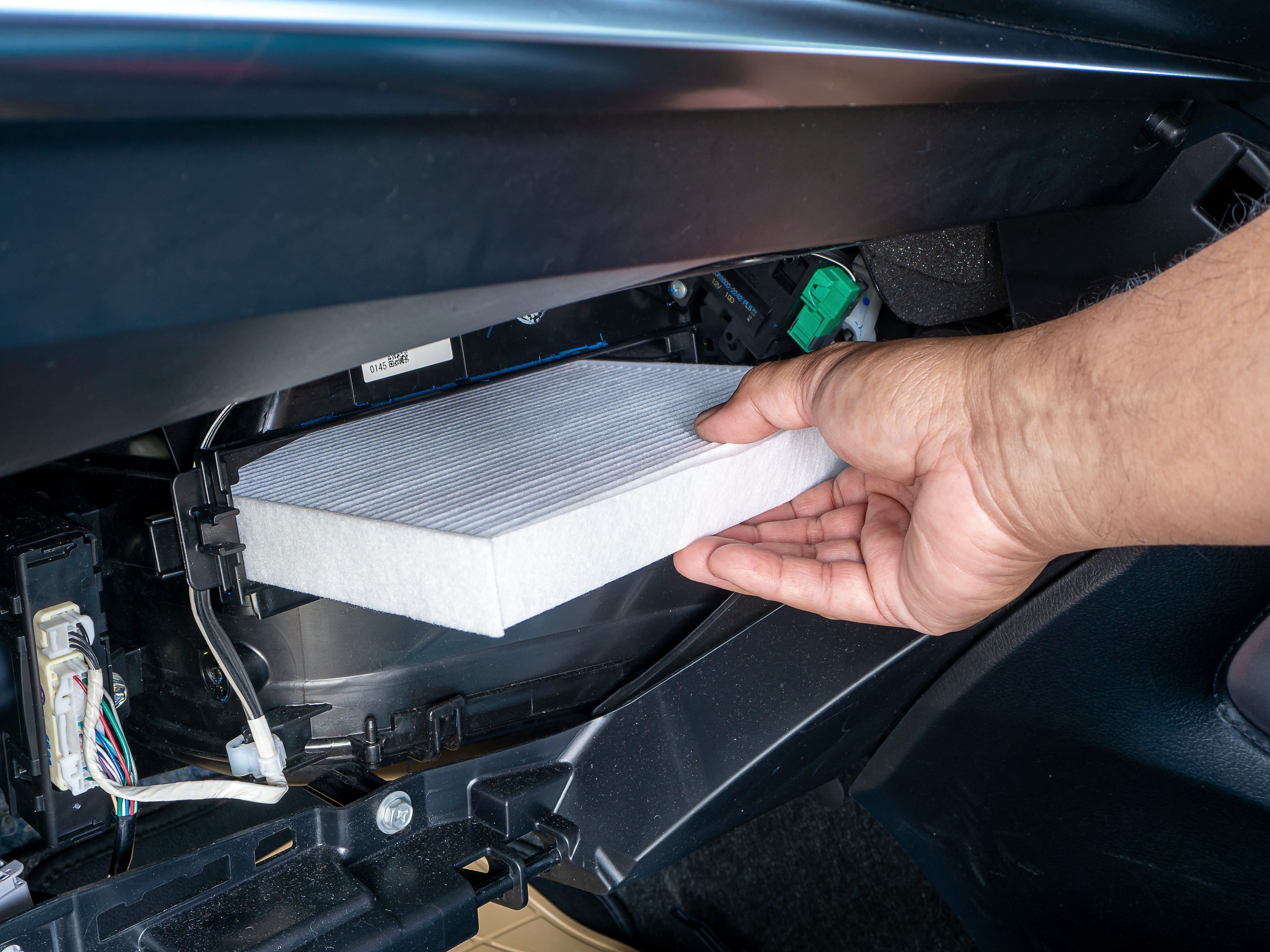
Replace the cabin air filter. On many cars it’s behind the glove box and takes 5 to 15 minutes. If the filter is packed with leaves, pet hair, or dust, you can see the problem instantly.
If airflow is still weak after a new filter, you may have a failing blower motor, a blower resistor or control module, or a stuck blend or recirc door.
3) AC condenser blocked or not being cooled
The condenser sits in front of the radiator and dumps heat from the refrigerant. If it cannot shed heat, the AC will blow warm.
What you’ll notice
- AC is cooler at highway speeds but warm at idle or in traffic
- System performance drops on very hot days
Easy checks
- Look through the grille: is the condenser packed with bugs, dirt, or leaves?
- Check for bent fins: light fin damage is normal; heavy flattening reduces airflow.
Easy fix
Gently clean debris from the front of the condenser. Use low-pressure water and clean from the engine side outward if possible to push junk back out. Do not use a pressure washer up close, it will fold fins over like wet cardboard.
When to go to a shop
If the condenser is leaking (oily wet spots) or badly damaged, it likely needs replacement and a proper recover/evacuate and recharge.
4) Cooling fan not running (or wrong speed)
At idle and low speed, your radiator fans pull air through the condenser. If the fan is dead, weak, or not commanded on, AC performance tanks, especially when stopped.
What you’ll notice
- AC cold while moving, warm when stopped
- Engine temperature may creep up in traffic
Easy checks
- With the engine idling and AC on, look (carefully) to see if the radiator fans are running.
- If your engine temp starts rising, shut the AC off and address the cooling issue first.
When to go to a shop
Fan diagnostics can involve relays, control modules, fan resistors, wiring, or fan motors. If you are not comfortable testing power and ground with a multimeter, this one is worth paying a pro for.
5) Compressor not engaging
No compressor means no cooling, even though the blower works fine.
What you’ll notice
- Air is room-temp no matter what
- No change in engine sound or idle when AC is switched on (varies by vehicle)
Easy checks
- Check the AC fuse(s) and relay: your owner’s manual or fuse box diagram will point you to them.
- Know your compressor type: some vehicles have a traditional clutch you can see engage, some are variable displacement, some are clutchless, and many hybrids and EVs use an electric compressor. So this check is vehicle-dependent.
What this usually means
- Low refrigerant can prevent operation because the pressure switch or sensor logic protects the compressor.
- A bad relay, blown fuse, pressure sensor issue, or wiring fault can stop operation.
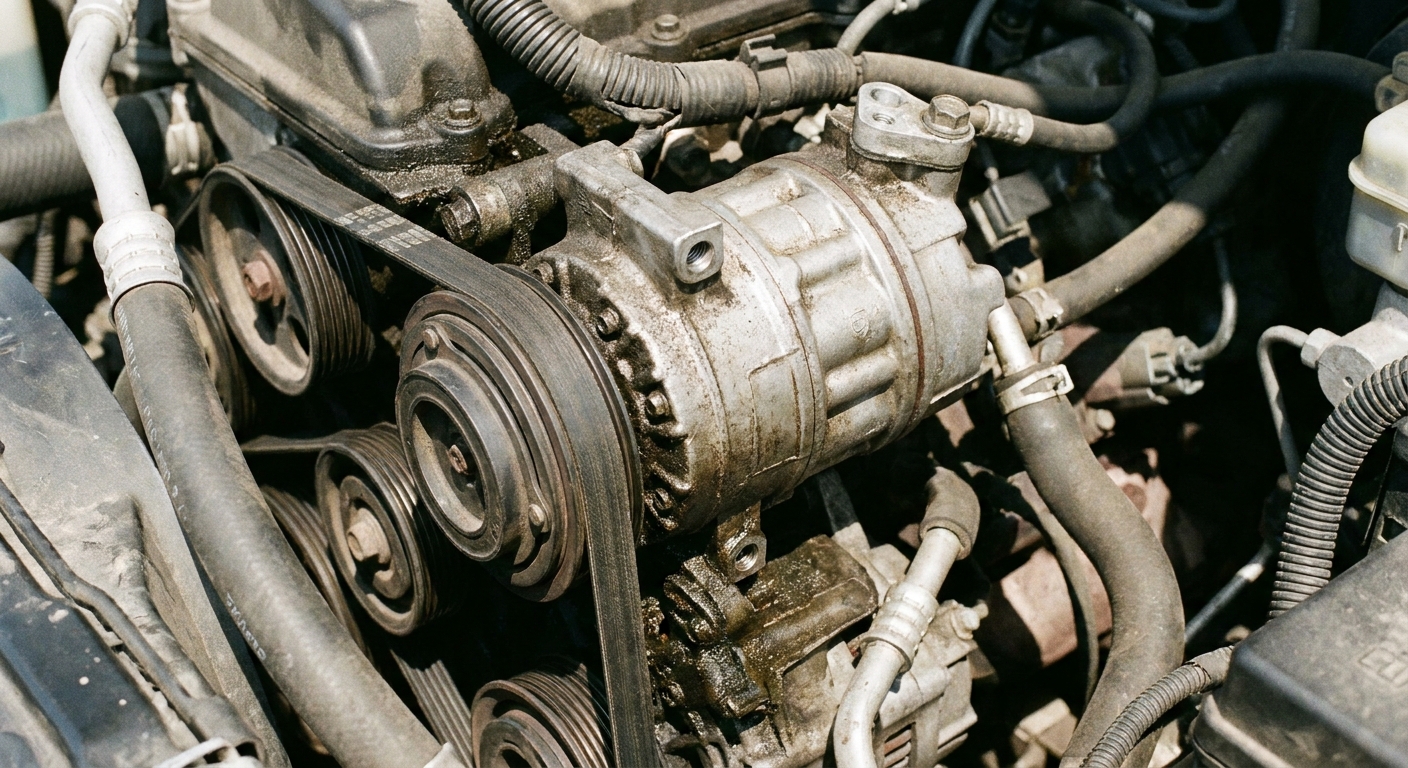
- A failed clutch (if equipped), failed control valve (common on variable displacement units), or failed compressor can also be the culprit.
When to go to a shop
If you have power and command but the compressor will not operate, or if it makes loud grinding noises, get it diagnosed. Compressors can scatter debris through the system, and that can turn one part into several.
6) Blend door issue
Your HVAC box has doors that route airflow through the heater core or around it. If a blend door actuator fails or the door sticks, you can end up with warm air even when the AC system itself is working.
What you’ll notice
- One side cold and the other side warm (dual-zone systems commonly show this)
- Temperature changes randomly or won’t respond to the knob or buttons
- Clicking or tapping noises behind the dash when you change temp settings
Easy checks
- Switch from full cold to full hot and listen for movement behind the dash.
- Try different modes (dash vents, floor, defrost) and see if airflow direction changes normally.
When to go to a shop
Some actuators are easy to access, others require dash work. Diagnosis is usually straightforward with a scan tool and basic testing, but repairs can range from simple to “half the dashboard comes apart.”
7) Expansion valve or orifice restriction
The expansion device meters refrigerant into the evaporator. If it’s restricted, or if moisture has gotten into the system and freezes, you can lose cooling or have intermittent cooling.
What you’ll notice
- AC starts cold, then fades warmer over time
- Sometimes cooling returns after shutting the car off for a while
- Lines under the hood may show unusual frosting patterns (not always visible)
Easy checks
There is not much you can safely check here without gauges and experience. Intermittent cooling can also be low refrigerant, so don’t assume restriction right away.
When to go to a shop
This is a “proper AC machine” job. The system often needs recovery and evacuation, and if the system is opened for repair it typically needs a new receiver-drier or accumulator. Depending on what’s found, the fix may include replacing the expansion valve or orifice tube and removing moisture and contamination correctly.
Two other common culprits
Heater control valve issue (vehicle-dependent)
Some vehicles use a heater control valve to regulate hot coolant flow through the heater core. If it sticks open, you can get unwanted heat bleeding into the HVAC box, especially at idle. The symptom can feel like a weak AC that never quite gets cold.
Evaporator icing (low charge or sensor issue)
If the AC blows cold at first, then airflow drops off and it gets warmer, the evaporator can be icing up. Low refrigerant can contribute, and a faulty evaporator temp sensor or thermistor can fail to prevent freeze-up. A shop can confirm this quickly with temperature readings and scan data.
DIY steps worth doing
- Replace the cabin air filter if you have weak airflow or it’s overdue.
- Clean the condenser face if it’s visibly clogged.
- Verify radiator fans run with AC on.
- Check fuses and relays related to HVAC and AC compressor.
- Use recirculation in high heat and keep windows up for faster cooldown.
If you do those and it still blows warm, you’ve narrowed it down to the part of the system that usually needs gauges, leak testing, and scan data.
When to stop DIY
Here’s my practical line in the sand. Book a diagnostic if any of these are true:
- You suspect a refrigerant leak (cooling faded over weeks or months).
- The compressor makes grinding, squealing, or rattling noises.
- AC works only sometimes and you cannot tie it to vehicle speed or settings.
- Your vehicle uses a newer system (many are variable displacement, clutchless, or electric) and you are not sure what “normal” looks like.
- The engine temperature runs hotter than usual when the AC is on.
Mechanic-to-driver advice: paying for one hour of real AC diagnosis is usually cheaper than guessing with parts or cans. AC systems are sensitive to charge amount, airflow, and correct oil levels.
FAQ
Why is my car AC cold while driving but warm when stopped?
That pattern usually points to an airflow problem at idle, like radiator fans not running, a dirty condenser, or a low refrigerant charge that only seems acceptable when there is lots of airflow through the front of the car.
Can I just recharge my AC and be done?
If it’s low, it’s leaking. A recharge might help short-term, but the correct fix is to find the leak and recharge by weight. If you recharge repeatedly, you risk overcharging and damaging components. Also make sure you are using the correct refrigerant type for your vehicle.
How do I know if it’s the compressor?
If the compressor never runs, runs then immediately shuts off, or makes loud mechanical noise, it could be the compressor. But low refrigerant and electrical faults can look similar. Proper diagnosis uses pressure readings and command data.
Does a bad cabin air filter make the AC not cold?
It can make it feel like the AC is not working because airflow is restricted. The air might be cold, but not enough is getting into the cabin to cool you down.